A city wakes up to contamination alarms. Officials move quickly to reassure the public. The first explanation sounds ordinary enough: faulty sensors, an industrial incident, nothing to panic about.
But what if the alarms worked exactly as intended?
And what if somebody was watching to see what happened next?
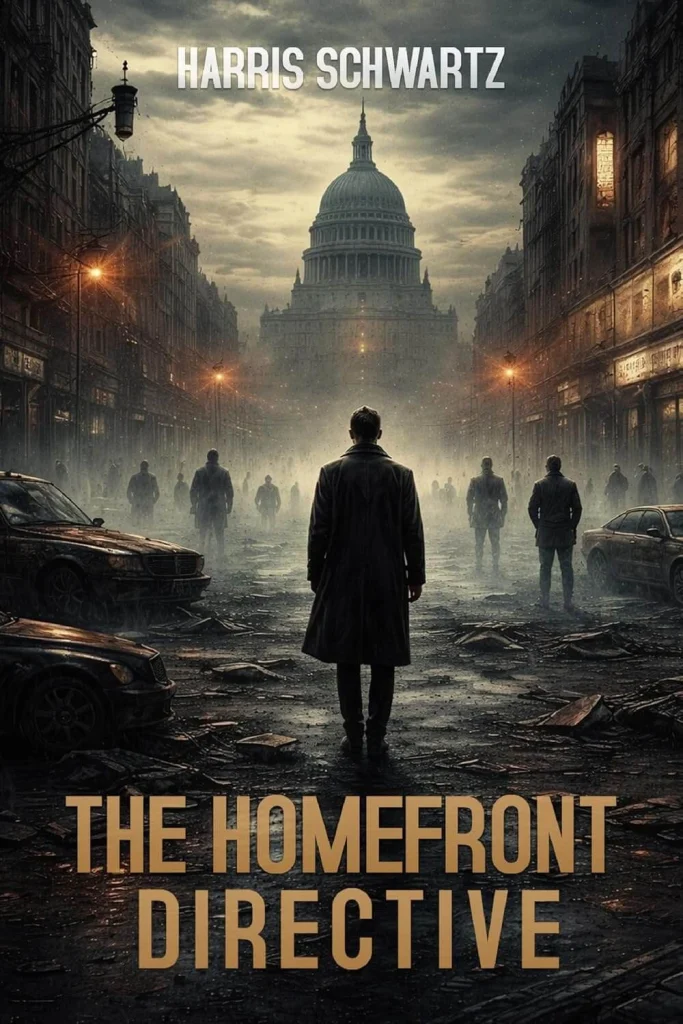
That is the unsettling idea at the center of The Homefront Directive, a thriller by Harris Schwartz that begins with an incident in Denver and expands into a much larger investigation involving intelligence agencies, scientific research, critical infrastructure, and a network that seems to understand the weaknesses of modern institutions remarkably well.
It is the kind of setup that makes you suspicious of the explanation long before the characters can prove anything is wrong.
Content
The Denver Incident Is Just the Beginning
The novel opens at 2:14 in the morning.
Dr. Erik Vance stands on a warehouse rooftop overlooking Denver while a team below carries out a carefully planned operation. They are not behaving like amateurs. Equipment is prepared, movements are coordinated, and surveillance has been accounted for.
Yet Vance insists on an unusual distinction.
What they are doing, in his mind, is not an attack. It is a demonstration.
Their objective is attention.
Vance wants to expose weaknesses in systems that millions of people assume are working correctly. That includes the infrastructure itself, but also what comes afterward. Detection. Government response. Interagency coordination. Public communication.
By morning, the consequences have started.
For most people, the Denver incident is simply another troubling headline.
For intelligence analyst Jack Rence, it is something else entirely.
Jack Rence Has Seen Pieces of This Before
Jack has spent months studying a pattern that has never quite become concrete enough to act upon.
Encrypted communications. Suspicious financial connections. Recruitment activity. Groups with little obvious reason to cooperate.
There has been enough information to make him suspicious, but not enough to reveal what he is actually looking at.
Denver changes the equation.
The incident triggers a connection to Jack’s existing investigation, and he and analyst Maya Torres begin digging into what happened.
Almost immediately, the official explanation and the available intelligence start moving in different directions.
The public is being reassured.
Jack and Maya are becoming considerably less reassured.
Then they discover Denver might not be unique.
How Do Seventeen Incidents Go Unnoticed?
One of the more interesting ideas in The Homefront Directive is surprisingly simple.
Nobody has to hide every piece of a conspiracy if nobody is looking at all the pieces together.
As the investigation develops, anomalies emerge across seventeen American cities. They involve different types of infrastructure and have been examined by different organizations.
Individually, they can be explained.
Together, they suggest planning.
That distinction sends Jack’s investigation in a new direction.
Someone may have been studying how quickly authorities identify unusual events, how agencies communicate, where information gets delayed, and how institutional responses unfold.
Suddenly, the earlier incidents look less like attacks and more like preparation.
Preparation for what is another question.
Erik Vance Believes He Has a Reason
Schwartz also spends time showing how Vance became the person capable of organizing something like this.
Before the movement, there was Dr. Erik Vance, a researcher working on technology with promising medical applications.
Then he discovered another potential use for the work.
Vance believed the research was crossing an ethical boundary, so he followed the channels that were supposed to exist for precisely that situation. He documented what he had found and tried to raise the alarm.
Instead, his professional life began collapsing around him.
The experience destroyed his belief that institutions could reliably police themselves.
It is important because The Homefront Directive does not require readers to accept Vance’s conclusions in order to understand how he reached them.
His response is extreme. His grievance is more complicated.
That difference gives the conflict some needed texture.
This Is Also a Story About Bureaucracy
Jack and Maya are not investigating from inside a perfectly functioning intelligence machine.
Quite the opposite.
Different agencies have overlapping responsibilities. Information is divided between systems. Officials have political concerns alongside security concerns. Public communication can become an objective of its own.
Meanwhile, the network they are chasing appears to understand these limitations.
That creates a different kind of cat-and-mouse game.
The question is not simply whether Jack can find the people responsible.
It is whether he can understand them using an investigative structure they may already know how to manipulate.
The Network Has an Unusual Recruiting Tool
As Jack and Maya move further into the investigation, the people connected to the movement become difficult to place into a single ideological box.
Their backgrounds do not neatly align.
What they share is something broader: a sense of betrayal by institutions they once trusted.
That turns out to be powerful common ground.
Vance’s worldview can speak to scientists who believe research was suppressed, whistleblowers who feel they were punished for speaking out, professionals who witnessed institutional failures, and others whose individual experiences have left them distrustful of the larger system.
Instead of creating agreement on everything, the movement gives them one thing to agree about.
The system is the problem.
For Jack, that realization makes the investigation considerably more difficult. A conventional organization can be mapped through leadership, membership, financing, and operations.
A movement built around an idea is harder to draw on a board.
Why The Homefront Directive Stands Out
There is plenty of action and intelligence work here, but the premise works because the threat is not entirely abstract.
Modern life really does require trust.
Most people cannot personally verify the safety of their drinking water, inspect the power grid, audit scientific research, or see what happens inside an intelligence agency. We depend on specialists and institutions to do those things.
Schwartz takes that ordinary reality and uses it as the foundation of the suspense.
The result is a novel likely to appeal to readers who enjoy political thrillers, conspiracy fiction, intelligence stories, scientific suspense, and plots where the investigation becomes larger with every answer.
It also gives readers an antagonist whose most dangerous weapon may not be the technology at his disposal.
It may be his ability to convince people that he is right.
A New Thriller for Conspiracy and Intelligence Fiction Readers
The Homefront Directive is written by Harris Schwartz and published by Writers of the West. The book’s manuscript credits Schwartz as the author and Writers of the West as publisher.
If you like thrillers involving covert networks, government intelligence, institutional secrets, scientific threats, and conspiracies that become more complicated the deeper someone investigates them, this one is worth a look.
Find The Homefront Directive on Amazon

Lisa’s the history buff who turns pages into portals to the past. She’ll transport you through time with her historical fiction recommendations and insightful reviews.